

May 3, 2026
Before you haul your sofa to the curb, ask yourself this: is it worn out, or is it just dirty? In most cases, professional upholstery cleaning in Seattle can restore furniture that looks done – and save you a significant chunk of what a replacement would cost.

You know the couch. The one that’s been through it – the dog’s favorite nap spot, the scene of a few red wine incidents, three years of rainy-season boot prints tracked in from Capitol Hill sidewalks. It doesn’t look the way it used to. It might even smell a little. You’ve thought about replacing it more than once.
But here’s the thing: upholstery cleaning Seattle professionals see furniture like yours every week. And the majority of sofas that look “done” are actually perfectly salvageable. The grime, the odor, the dull fabric – these are cleaning problems, not structural ones. What looks like end-of-life is often just a deep clean away from feeling like new.
This guide walks you through the clean-or-replace decision honestly, explains what a real upholstery restoration Seattle WA service actually does, and gives you the Seattle-specific context that matters when your furniture lives in one of the wettest cities in the country.
Clean or Replace? How to Decide Before You Give Up on Your Furniture
The single biggest factor is structural integrity – not appearance. If the frame is sound and the fabric is intact, professional cleaning almost always delivers a result worth the investment. Replacing furniture that simply needs a proper clean is one of the most common – and most avoidable – unnecessary expenses in a Seattle home.
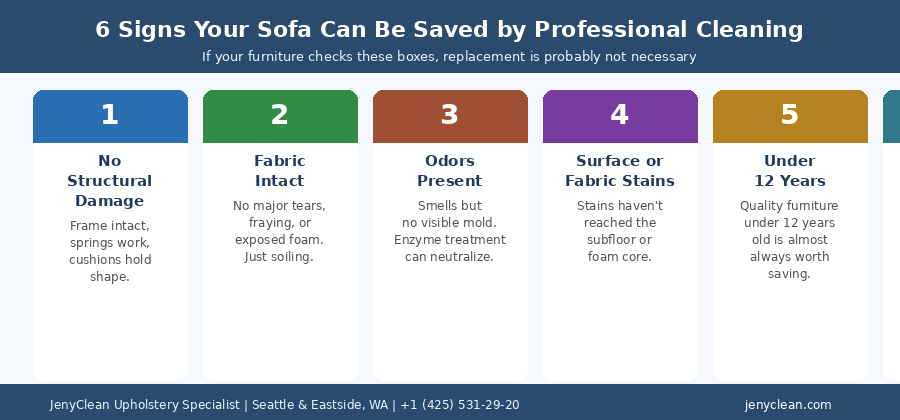
The when to replace vs clean upholstery question doesn’t have a universal answer, but it does have a clear framework. JenyClean’s upholstery specialist Vladimir starts every Seattle assessment with the same six questions – and they’re the same ones you should ask yourself before making a decision:
- No structural damage – if the frame is solid, springs intact, and cushions still hold their shape, the piece has life in it regardless of how it looks on the surface
- Fabric is intact – tears, major fraying, or large sections of exposed foam usually signal the end; surface soiling and staining do not
- Odors are present but not mold-based – pet odors, musty smell, smoke – these can be neutralized with enzyme treatments; actual mold growth inside the cushion fill is a different story
- Stains are surface or fabric-deep – stains that have soaked into the subfloor or saturated the foam core may be beyond restoration; fabric-level staining almost always responds to professional treatment
- Under 12 years old – quality upholstered furniture has a structural lifespan of 15-25 years; anything under 12 years is almost always worth cleaning rather than replacing
- Sentimental or financial value justifies the cost – a custom piece, inherited furniture, or a sofa that cost significantly more than a replacement would – these tip the scale toward restoration even in closer cases
Use the decision guide below as a starting point. It covers the most common situations sofa cleaning service Seattle clients bring to JenyClean – from post-pet disasters to simply neglected fabric that hasn’t been professionally cleaned in years.
Table 1. Clean or Replace? Upholstery Decision Guide – Seattle, WA
Situation | Recommendation | Reason |
Pet stains with odor, fabric intact | Clean | Enzyme treatment neutralizes odor compounds at source; fabric-level stains respond to extraction |
Faded, dull fabric – no structural damage | Clean | Professional extraction removes embedded oils and soil that cause fading; fabric often refreshes significantly |
Musty smell after wet Seattle winter | Clean | Surface mold spores and moisture odor respond to professional cleaning; no replacement needed |
Red wine / coffee stain, set in 1+ year | Clean (try first) | Set stains need pre-treatment but often lift; worth attempting before replacing |
Tears in fabric, foam exposed | Replace or reupholster | Cleaning cannot repair fabric damage; consult a reupholstery specialist instead |
Deep mold inside cushion fill | Replace | Internal mold cannot be safely addressed by cleaning; structural replacement required |
Frame broken, cushions collapsed | Replace | No amount of cleaning fixes structural failure; time to move on |
Post-renovation dust throughout | Clean | Construction dust on upholstery responds extremely well to professional extraction |
Furniture over 15 years, cosmetically tired | Assess in person | Depends on structural condition; free assessment from JenyClean recommended |
When in doubt, a professional assessment costs nothing and tells you exactly where your furniture stands. JenyClean offers free upholstery consultations for Seattle homeowners – call +1 (425) 531-29-20 and describe what you’re working with.
What Professional Upholstery Restoration Cleaning Actually Does
A restoration clean is not the same as a maintenance clean. It targets layers of embedded soil, neutralizes odor at the source, pre-treats set stains with specific chemistry, and extracts far deeper than any surface cleaning method. Done correctly, the result can look – and smell – dramatically different from where you started.
When Vladimir arrives for a professional upholstery cleaning Seattle restoration appointment, the process is methodical. It starts with a full fabric assessment: fiber type, cleaning code, condition of the surface, any stains or odor sources. This isn’t a formality – it determines which products and techniques are used, and skipping it is how furniture gets damaged.
After assessment, stains are pre-treated individually. Different stains require different chemistry – protein stains (blood, pet urine) need enzyme-based treatment, tannin stains (coffee, tea, wine) need an alkaline solution, oil-based stains need a solvent approach. Applying a generic stain product to all of them doesn’t work and often makes things worse. Sofa stain removal Seattle WA at a professional level is stain-specific, fabric-specific, and done in the right sequence.
The main cleaning step – typically hot water extraction for most synthetic and cotton fabrics – follows pre-treatment. Extraction pulls soil, cleaning agents, pet dander, and allergens out of the fiber at depth. For fabrics with S or X codes, dry solvent methods are used instead. The drying protocol matters as much as the clean itself: controlled drying prevents watermarks and ensures no moisture is trapped in the foam core.
Pet Stains and Odors: The Toughest Restoration Challenge
Pet urine is in a category of its own. Seattle is a dog city – Labrador retrievers, golden doodles, huskies, and every mixed breed imaginable live in these homes. And at some point, an accident happens on the couch. The visible stain is only part of the problem.
Urine soaks through fabric, through cushion fill, and in severe cases into the backing material. As it dries, uric acid crystals form in the fiber and remain odor-inactive until reactivated by humidity. Seattle’s climate is perfect for reactivation – and that’s why pet odor removal upholstery Seattle is one of JenyClean’s most requested services, especially in autumn and winter when homes are closed up and humidity rises.
Enzyme-based treatments work by breaking down the uric acid crystals rather than masking them with fragrance. Applied correctly – with adequate dwell time and proper extraction – they can eliminate odor from fabric and the upper layers of cushion fill. Deep saturation that has reached the inner foam core is harder to address; in those cases, cushion replacement combined with a fabric clean is the honest recommendation. JenyClean will tell you which situation you’re dealing with – no upsell, just an honest assessment.
Faded Fabric and Matting: Can Cleaning Reverse the Damage?
Fading and matting are two different problems with two different answers. Fabric that looks faded because of embedded soil – dulled by years of body oils, dust, and surface grime – often responds dramatically to professional extraction. The color was always there. It was just buried.
True sun fading – color change caused by UV exposure on a south-facing Seattle living room window – is a different matter. Cleaning can refresh the texture and remove the grunge layer, but it cannot restore color that has been chemically altered by light. This is an honest limitation that JenyClean will flag during assessment. Fabric furniture cleaning Seattle can do a great deal, but it doesn’t perform miracles on genuine UV damage.
Matting – where microfiber or velvet pile has been crushed flat by heavy use – can sometimes be partially restored through professional brushing and low-moisture extraction. The pile won’t return to day-one condition, but the improvement is often meaningful enough to justify cleaning over replacement. After cleaning, a fabric protector application adds a barrier that reduces future soiling and makes the next clean easier.
Upholstery Cleaning for Seattle Homes: Why the Climate Matters
Seattle averages over 150 rainy days per year. That moisture doesn’t just stay outside – it comes in on shoes, coats, and pets, and it settles into upholstery. Seattle homes need more frequent professional upholstery cleaning than the national average, and the reasons are practical, not commercial.
Upholstery cleaning Seattle WA has a local dimension that homeowners in drier climates don’t deal with the same way. Moisture is the common thread. In a city that’s damp for eight months of the year, upholstered furniture absorbs ambient humidity, accelerates mold spore germination in fabric, and traps the damp soil tracked in from outside at a higher rate than furniture in, say, Phoenix or Denver.
The allergen load is also higher. Seattle’s surrounding forests – the Douglas firs, red alders, and big-leaf maples that make the Pacific Northwest beautiful – release significant pollen loads in spring. That pollen comes through open windows and settles into fabric. Dust mite populations thrive in Seattle’s humidity range. Eco-friendly upholstery cleaning Seattle via professional hot water extraction removes these allergens at depth – much more effectively than surface vacuuming.
For Seattle homeowners with allergies or asthma, annual professional upholstery cleaning isn’t a luxury – it’s a meaningful contributor to indoor air quality. JenyClean uses non-toxic, biodegradable cleaning agents throughout every upholstery cleaning Seattle appointment – important in a city where environmental consciousness isn’t a marketing angle, it’s a genuine community value.
PROFESSIONAL INSIGHT Seattle’s shoulder seasons – October through November and March through April – are the best times to book professional upholstery cleaning. In autumn, you’re clearing the summer’s accumulated outdoor traffic before you close up the house for winter. In spring, you’re removing the pollen and humidity buildup from the wet season before peak allergen months. Booking in these windows also means better availability – summer is when everyone thinks of cleaning, but the shoulder season slots are easier to get and the results matter just as much. |
What to Expect from a Professional Upholstery Cleaning Visit in Seattle
A JenyClean upholstery visit follows a clear sequence: fabric inspection, code check, stain pre-treatment, cleaning, controlled drying, and post-clean review. Most appointments are completed in 2 to 4 hours depending on the number of pieces.
If you’ve never booked professional upholstery cleaning Seattle before, knowing what to expect makes the whole process easier. Here’s a straightforward walkthrough of what happens during a JenyClean upholstery appointment:
- Arrival and fabric assessment (15-20 min) – Vladimir inspects every piece, identifies fabric types and cleaning codes, checks for stains and odor sources, and confirms the cleaning method before starting. If there’s anything unexpected – hidden damage, a fabric that needs a different approach – you’ll know before a product is applied.
- Pre-treatment of stains and problem areas (15-30 min) – Set stains, pet odor zones, and heavily soiled areas get pre-treated with chemistry matched to the specific stain type and fabric code. Dwell time is allowed for enzymes and solvents to work before the main clean.
- Main cleaning pass (30-90 min per piece) – Hot water extraction, dry encapsulation, or solvent method depending on the fabric. Systematic passes, consistent pressure, complete coverage. No rushing – thorough extraction takes time.
- Drying and air movement (30-60 min post-clean) – Fans are used to accelerate drying and prevent any moisture from sitting in the fabric. In Seattle’s humidity, proper post-clean drying protocol prevents the exact conditions that cause mold – particularly important in closed rooms during rainy season.
- Post-clean review and fabric protector option – Vladimir walks through the results with you, notes any areas where improvement was limited by fabric condition, and can apply a fabric protector to extend time between cleans and make future stains easier to remove.
Furniture is typically dry enough for light use within 3 to 6 hours, and fully dry within 12 hours. Avoid sitting directly on cleaned fabric until it’s fully dry – it’s comfortable to the touch before it’s structurally dry, and pressure during drying can cause marks. Sofa cleaning service Seattle appointments are designed to fit into your day with minimal disruption.
Upholstery Cleaning Cost vs. Furniture Replacement in Seattle
Replacing a quality sofa in Seattle typically costs $800 to $3,000+. Professional upholstery cleaning costs a fraction of that. The math almost always favors cleaning – and the result is furniture that fits your home, not a new piece you need to wait 8 weeks for.
Couch cleaning cost Seattle is one of the first questions people ask – and it’s the right question to ask. Here’s the comparison that makes the decision clear. These are conservative market estimates for Seattle; JenyClean provides exact flat-rate quotes before every booking.
Table 2. Professional Cleaning vs. Furniture Replacement – Seattle Cost Comparison
Item | Professional Clean (market range) | Replacement Cost (Seattle market) | Verdict |
Standard 3-seat sofa | Get a quote at jenyclean.com | $600 – $2,500+ | Clean wins |
Sectional sofa | Get a quote at jenyclean.com | $1,200 – $5,000+ | Clean wins |
Armchair / accent chair | Get a quote at jenyclean.com | $300 – $1,200+ | Clean wins |
Dining chairs (set of 4) | Get a quote at jenyclean.com | $400 – $1,800+ | Clean wins |
Ottoman / footstool | Get a quote at jenyclean.com | $150 – $600+ | Clean wins |
Leather sofa (full-grain) | Get a quote at jenyclean.com | $1,500 – $6,000+ | Clean wins strongly |
Furniture with structural damage | Not applicable | Market rate | Replace |
JenyClean provides flat-rate quotes before every appointment – call +1 (425) 531-29-20 or visit jenyclean.com to get your exact price. The point of this comparison isn’t to be coy about cost. It’s to show that the gap between cleaning and replacing is wide enough that in most scenarios, the decision isn’t close.
There’s also the replacement timeline to consider. Quality furniture that actually fits your Seattle home – the right dimensions for your living room, the right feel for how you use it – doesn’t show up immediately. Lead times on custom or semi-custom pieces run 8 to 16 weeks. A professional clean takes a day and delivers results the same week. For furniture worth keeping, professional upholstery cleaning Seattle is not just the cheaper option – it’s the faster and smarter one.
Your Seattle Furniture Deserves a Second Chance
Most Seattle sofas that end up on the curb didn’t need to be there. A thorough professional clean, properly done, gives furniture a meaningful second life – and the results consistently surprise people who expected less.
Seattle homeowners don’t throw things away carelessly. There’s a reason the repair culture is strong here, the second-hand market is robust, and people hold onto things that matter. Upholstery cleaning Seattle WA fits naturally into that ethos: restore what you have, extend its life, don’t replace it before its time.
If your sofa is structurally sound, if the fabric is intact, if the smell or the appearance is the problem – give it a professional clean first. JenyClean’s Vladimir will be honest with you about what’s achievable and what isn’t. The assessment is free, the results speak for themselves, and the Satisfaction Guarantee means you’re not taking on any risk.
JenyClean serves Seattle and the greater Eastside – Issaquah, Bellevue, Sammamish, Redmond, and Kirkland. For fabric furniture cleaning Seattle bookings or a free upholstery consultation, visit our Seattle service area or call +1 (425) 531-29-20. Eco-friendly, non-toxic, and backed by our Satisfaction Guarantee.
Ready to find out if your furniture can be saved? Book a professional upholstery cleaning in Seattle – free assessment, flat-rate quote, results you can see. Book My Seattle Upholstery Clean |
Frequently Asked Questions
Q1: Can professional upholstery cleaning really restore an old sofa in Seattle?
In most cases, yes. Upholstery cleaning Seattle can restore sofas that look worn, smell stale, or have years of embedded soil – as long as the structure is intact and the fabric isn’t torn. What looks like a furniture replacement situation is often a deep cleaning situation. JenyClean offers a free assessment before every booking.
Q2: How do you remove pet odors from upholstery in Seattle?
Pet odor removal upholstery Seattle requires enzyme-based treatment that breaks down the uric acid crystals causing the smell, not just fragrance masking. JenyClean applies enzyme treatments with proper dwell time, then extracts thoroughly. For severe saturation into foam fill, cushion replacement may be needed – Vladimir will give you an honest assessment.
Q3: How often should I have my upholstery professionally cleaned in Seattle?
Annually is the right baseline for upholstery cleaning Seattle WA on daily-use pieces. Seattle’s humidity and pollen load accelerate soiling compared to drier climates. Homes with pets or children benefit from every 6-9 months. Eco-friendly upholstery cleaning Seattle from JenyClean uses non-toxic products safe for every household.
Q4: What does upholstery cleaning cost in Seattle, WA?
Couch cleaning cost Seattle depends on fabric type, number of pieces, and current condition. JenyClean provides flat-rate quotes before every appointment – call +1 (425) 531-29-20 or get an instant quote at jenyclean.com. No hourly billing, no surprises.
Q5: Is JenyClean’s upholstery cleaning eco-friendly and safe for Seattle homes?
Yes. Every product used in JenyClean’s upholstery cleaning Seattle service is non-toxic, biodegradable, and free of harsh fumes – important for Seattle’s environmentally-conscious households and for homes with children, pets, or sensitivities. Eco-friendly upholstery cleaning Seattle is our default approach, not an upgrade.