

May 3, 2026
Every piece of upholstered furniture in your Kirkland home has a cleaning code stitched into its tag – and ignoring it is how sofas get ruined. This guide explains exactly what each fabric type needs, what you can safely do yourself, and when to call in a professional upholstery specialist.
That velvet armchair you found at a Kirkland boutique. The linen sectional that finally makes your living room feel grown-up. The microfiber sofa your kids have claimed as their territory since day one. Every one of them is different – different fibers, different vulnerabilities, different cleaning codes, and different consequences if you get it wrong.
Upholstery cleaning Kirkland isn’t one thing. It’s a family of approaches that depend entirely on what your furniture is made of. The most common mistake Kirkland homeowners make isn’t laziness – it’s using a perfectly reasonable cleaning product on the wrong fabric. A water-based cleaner on an S-code sofa. A generic spray on microfiber. Good intentions, real damage.
JenyClean’s upholstery specialist Vladimir has cleaned furniture across Kirkland’s Rose Hill craftsmans, Norkirk family homes, and Totem Lake new builds. The question he hears most often isn’t ‘how do I clean this?’ – it’s ‘did I already ruin it?’ This guide helps you avoid that conversation entirely.
Why Your Upholstery Type Determines Everything About Cleaning
Before any cleaning product touches your furniture, you need to know the fabric code. It’s printed on a small tag – usually under a cushion or on the frame. That code is the difference between a refreshed sofa and a ruined one.
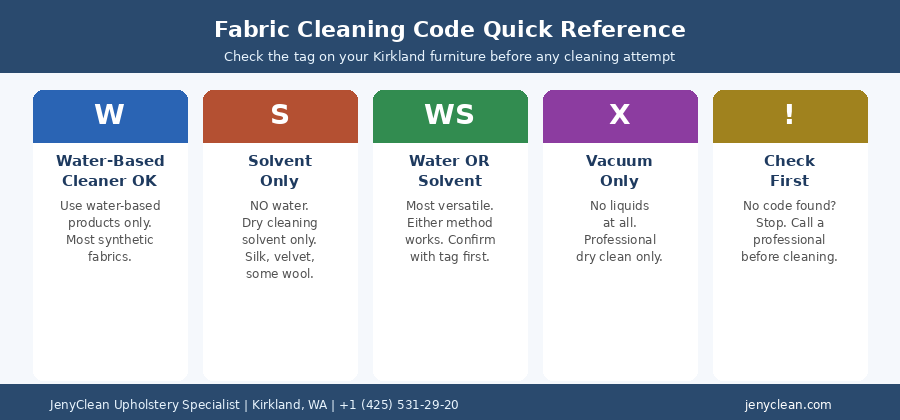
Furniture manufacturers assign every upholstered piece a cleaning code based on its fiber content and construction. Four codes cover almost everything you’ll encounter in a Kirkland home:
- W – Water-based cleaners only. Most synthetic fabrics, many performance blends.
- S – Solvent-based (dry) cleaners only. No water at all. Silk, velvet, some wools, acetate.
- WS – Either water-based or solvent cleaners are safe. The most forgiving code.
- X – Vacuum only. No liquid of any kind. These fabrics must be professionally dry-cleaned if soiled.
These codes aren’t suggestions. Using water on an S-coded sofa can cause permanent ring marks, shrinkage, or color bleeding that no amount of re-cleaning will fix. Using a solvent on a W-coded synthetic can break down the fiber bonding and leave the fabric stiff or discolored. Upholstery cleaning Kirkland WA professionals check the code before they unpack a single product.
There’s also the warranty question. Most furniture manufacturers include care requirements in their warranty terms. Using an incorrect cleaning method – even once – can void coverage for fabric defects and wear. Here are the five most common ways Kirkland homeowners accidentally void their sofa warranty while trying to clean it:
- Using the wrong cleaning solvent – applying a water-based product to an S-code fabric (or vice versa) immediately voids most manufacturer warranties
- Over-wetting the fabric – soaking upholstery causes moisture to reach the foam core, leading to mold, odor, and structural breakdown
- Heat drying – using a hair dryer or space heater to speed drying shrinks natural fibers and can melt synthetic weaves
- Abrasive scrubbing – circular scrubbing motions break down the fabric pile on velvet, chenille, and microfiber, causing permanent texture damage
- Skipping the manufacturer cleaning code – the tag exists for a reason; bypassing it is the most avoidable mistake in furniture care
None of this is meant to intimidate you. It’s just the reality of owning quality furniture – and Kirkland homes tend to have quality furniture. Understanding these rules means your pieces last decades instead of years. Professional upholstery care Kirkland specialists like Vladimir exist precisely so you don’t have to memorize every fiber’s quirks yourself.
Fabric Sofas and Chairs: What Professional Cleaning Involves
Professional fabric cleaning starts with identifying the fiber, checking colorfastness, pre-treating stains, and choosing between hot water extraction and dry encapsulation – all before a single pass with the cleaning tool. It’s methodical, not rushed.
When Vladimir arrives for a furniture cleaning service Kirkland WA appointment, the first thing he does is not start cleaning. He inspects. Fabric type, cleaning code, existing stains, any discoloration, the condition of the seams – he builds a picture of what the piece needs before selecting a method. That pre-assessment is what separates a professional result from a DIY gamble.
Use the table below as a reference guide for the fabric types most commonly found in Kirkland homes – from older craftsman-era pieces with natural fibers to the performance blend sectionals popular in newer Totem Lake construction:
Table 1. Upholstery Fabric Cleaning Guide – Kirkland, WA Reference
Fabric Type | Cleaning Code | Best Method | DIY Safe? | Frequency |
Cotton | W or WS | Hot water extraction | Cautious | Every 12-18 months |
Linen | S or WS | Dry solvent / low moisture | Not recommended | Every 12 months |
Wool | S | Dry solvent only | No | Every 12-18 months |
Velvet | S or X | Dry solvent / vacuum only | No | Every 6-12 months |
Polyester | W or WS | Hot water extraction | Limited | Every 12-18 months |
Nylon | W or WS | Hot water extraction | Limited | Every 18-24 months |
Performance blend | W or WS | Low-moisture extraction | Yes (carefully) | Every 12-18 months |
Chenille | WS or S | Dry solvent preferred | No | Every 12 months |
Silk / Acetate | S or X | Dry solvent / professional only | No | Professional only |
Outdoor fabric | W | Water extraction | Yes | Every 6-12 months |
Natural Fabrics: Cotton, Linen, and Wool
Natural fibers are beautiful – and unforgiving. Cotton sofas and linen chairs are common in Kirkland’s older homes and in the interior-design-conscious households near the waterfront. They look and feel premium. They also shrink, bleed, and distort when exposed to the wrong cleaning method or excessive moisture.
Linen and wool almost always carry an S code – meaning water is not your friend. Even a ‘damp cloth’ approach on linen can leave a permanent ring. Cotton is more forgiving with a W or WS code, but it still requires careful technique: controlled moisture, proper extraction, and low-heat drying. How to clean fabric sofa Kirkland really depends on this first question – what is it made of?
For upholstery stain removal Kirkland on natural fabrics, the key is speed and restraint. Blot, don’t rub. Don’t apply water unless the code says W. And if the stain has set – stop. Set-in stains on natural fibers require solvent chemistry and professional technique to lift without spreading damage. Attempting it with household cleaners almost always makes things worse.
Synthetic Fabrics: Polyester, Nylon, and Performance Blends
Polyester and nylon are workhorses. They’re dimensionally stable, colorfast, and resistant to moisture – which is why they dominate in family rooms across Kirkland. The newer generation of performance blend fabrics (think Sunbrella indoor/outdoor, Crypton, Revolution) push this further: engineered specifically for households with kids, dogs, and Pacific Northwest mud.
That durability doesn’t mean they’re maintenance-free. Upholstery cleaning Kirkland for synthetic fabrics typically involves hot water extraction – essentially steam cleaning at a controlled temperature that pulls soil, pet hair, and built-up oils out of the fiber weave. The result is noticeable: polyester that’s looked dull for two years can come back to life after a professional extraction clean.
Pet hair deserves a special mention. Kirkland is a dog city. Labs, goldens, doodles of every variety – they all shed, and synthetic upholstery traps that hair deep into the pile where a standard vacuum barely reaches. Pet-safe upholstery cleaning Kirkland extraction removes both the visible hair and the dander, oils, and odor compounds that come with it.
Microfiber Upholstery: The Most Common Fabric in Kirkland Homes
Microfiber is everywhere in Kirkland family homes – and it’s the fabric most commonly damaged by well-intentioned DIY cleaning. The culprit is almost always water. Microfiber is a synthetic, but it marks easily when wet and dried without the right technique.
Walk into any Kirkland home built or renovated in the last fifteen years and you’ll likely find at least one microfiber piece. It’s popular for good reasons: soft, durable, relatively affordable, and kid-friendly. But microfiber upholstery cleaning Kirkland has a specific failure mode that catches homeowners off guard – watermarks.
Here’s what happens: someone spills something, grabs a damp cloth, blots the area. The surface dries. And where the water edge was, there’s now a visible ring – lighter or darker than the surrounding fabric, and seemingly impossible to remove. That ring is caused by water carrying surface soils outward and depositing them at the drying perimeter. It’s not a stain in the traditional sense – it’s a cleaning artifact.
Fixing it isn’t about cleaning harder. It requires re-wetting the entire panel or cushion to even out the soil distribution, then extracting it properly with the right equipment. Vladimir uses a low-moisture extraction method on microfiber that avoids the ring problem entirely: controlled application, consistent passes, and a specific drying technique that prevents edges from forming.
The other microfiber issue is texture. Aggressive scrubbing – or using a brush attachment in circular motions – damages the split fibers that give microfiber its softness. Once that nap is crushed or matted, no amount of cleaning restores it. Fabric cleaning guide Kirkland rule for microfiber: blot only, never scrub, and call a professional for anything beyond a small fresh spill.
PROFESSIONAL INSIGHT Microfiber’s cleaning code is almost always W or WS – but that doesn’t mean tap water is safe. Kirkland’s tap water has moderate mineral content, and water spots from mineral deposits are a real risk on light-colored microfiber. Vladimir uses distilled or deionized water for all microfiber cleaning at JenyClean – it’s a small detail that makes a visible difference, especially on cream, beige, or grey upholstery common in Kirkland interiors. |
Leather Furniture: Cleaning, Conditioning, and When to Call a Pro
Leather is the most durable upholstery material – but also the most sensitive to incorrect cleaning. The step most DIY guides skip is conditioning. Cleaning without conditioning strips the oils that keep leather supple, leading to cracking and fading over time.
Not all leather is the same, and this matters enormously for cleaning. Three grades show up most often in Kirkland homes:
- Full-grain leather – the highest quality, with natural surface texture intact. Develops a patina over time. Needs pH-balanced cleaning and regular conditioning. Most sensitive to harsh chemicals.
- Top-grain leather – the most common grade in mid-to-high-end furniture. Sanded for a uniform surface. More resistant than full-grain but still requires conditioning to prevent drying.
- Bonded leather – a manufactured product with a leather surface layer over a polyurethane base. Found in lower-priced furniture. Peels and flakes over time; professional cleaning can extend its life but cannot reverse deterioration.
Leather sofa cleaning Kirkland always involves two steps – clean, then condition. Skipping the conditioning step after a clean is like washing your hands and then never moisturizing: technically done, but the material pays for it over time. Leather loses natural oils during any cleaning process, and conditioning replenishes them. JenyClean includes conditioning as standard on every leather couch cleaning Kirkland WA appointment.
What does professional leather cleaning actually do that a wipe-down doesn’t? It extracts the body oils, sweat, and embedded soil that accumulate in the grain over months of use. That buildup is invisible early on but darkens the leather and creates a film that regular wiping spreads rather than removes. A professional clean lifts it out, restores the color clarity, and leaves the surface ready for conditioning to penetrate properly.
DIY leather cleaning is safe for minor surface dust and fresh spills – a dry microfiber cloth, or a slightly damp one with a pH-neutral soap for fresh marks. But annual professional cleaning is the right standard for leather furniture used daily. Kirkland’s dry indoor winters (when heating runs constantly) and humid summers create humidity swings that are particularly hard on leather – conditioning twice a year, not once, is the right approach here.
DIY vs. Professional Upholstery Cleaning in Kirkland: An Honest Comparison
DIY upholstery cleaning makes sense for fresh spills on forgiving fabrics. For set-in stains, natural fibers, microfiber, leather, or anything with an S or X code – a professional isn’t a luxury. It’s the correct tool for the job.
This isn’t a sales pitch for professional cleaning. Some situations genuinely call for a DIY approach – a quick blot on a fresh coffee spill, regular vacuuming, a damp wipe on sealed leather. But there’s a clear line where DIY becomes a risk, and it’s worth knowing where that line is before you start.
Table 2. DIY vs. Professional Upholstery Cleaning – Kirkland, WA
Factor | DIY Cleaning | JenyClean Professional |
Fabric code check | Often skipped – risk of damage | Always first step – non-negotiable |
Equipment | Consumer sprays, cloths, rental machines | Commercial extractors, solvent tools, conditioning gear |
Stain removal depth | Surface only – may spread stain | Pre-treatment, extraction, full soil removal |
Microfiber watermarks | Common outcome of DIY | Prevented with controlled moisture technique |
Natural fiber risk | High – shrinkage, color bleeding | Low – correct solvent, controlled application |
Leather conditioning | Often skipped | Included as standard on every leather clean |
Drying time | Hours to days – mold risk if rushed | Controlled drying, post-clean air movement |
Warranty protection | May void coverage if wrong method used | Manufacturer-compliant method for every fabric |
Pet hair/dander removal | Partial – surface level | Deep extraction from fiber weave |
Satisfaction guarantee | Your risk entirely | JenyClean Satisfaction Guarantee on every job |
The rental machine question deserves a direct answer: yes, fabric upholstery extractors can be rented from hardware stores. They work – on the right fabric, with the right settings, operated carefully. The problem is that most rental machines are calibrated for carpet, not upholstery. They deliver too much moisture, have poor extraction pressure, and can over-wet furniture to the point of reaching the foam core. When foam gets wet and isn’t dried properly, mold follows. It’s the worst outcome of a DIY clean, and it happens more often than people realize.
Upholstery stain removal Kirkland for set-in stains is another case where professional intervention is almost always the right call. Set-in stains have bonded with the fiber – removing them requires specific chemistry matched to both the stain type (protein, tannin, oil, synthetic dye) and the fabric code. Using a generic stain spray on a set-in red wine stain on a linen sofa is likely to create a larger, more permanent problem than the original stain.
JenyClean’s professional upholstery care Kirkland service covers all of this – fabric assessment, code-compliant cleaning method, stain pre-treatment, controlled extraction or dry cleaning, leather conditioning where applicable, and post-clean inspection. Call +1 (425) 531-29-20 to book an upholstery assessment for your Kirkland home.
Know Your Furniture, Protect Your Investment
Your furniture tells a story about how you live. The right cleaning approach keeps that story going for decades. The wrong one ends it faster than it should.
Kirkland homeowners invest in their living spaces. The furniture in a well-appointed Norkirk or Rose Hill home isn’t just functional – it’s chosen, it fits the room, it’s worth maintaining properly. Upholstery cleaning Kirkland WA is most effective when it’s proactive: annual professional cleaning for daily-use pieces, conditioning twice a year for leather, and quick professional intervention for any stain that doesn’t lift cleanly with a blot.
The fabric code on your sofa tag is the starting point for every decision. If it says S, water is your enemy. If it says X, only a vacuum and a professional should touch it. If it says W or WS, you have more options – but technique still matters. And if there’s no tag at all, stop and call professional upholstery care Kirkland before attempting anything.
Vladimir and the JenyClean team serve all of Kirkland – Rose Hill, Bridle Trails, Totem Lake, Norkirk, and the waterfront corridor. For furniture cleaning service Kirkland WA booking or a free upholstery assessment, visit our Kirkland service area or call +1 (425) 531-29-20. Flat-rate quotes, no surprises.
Ready to give your Kirkland furniture the care it deserves? Book a professional upholstery cleaning service with JenyClean – fabric assessment included, results guaranteed. Book Upholstery Cleaning in Kirkland |
Frequently Asked Questions
Q1: How often should I have my upholstery professionally cleaned in Kirkland?
For upholstery cleaning Kirkland on daily-use pieces, once a year is the right standard. Leather furniture benefits from professional cleaning plus conditioning twice a year. Homes with pets or children may need more frequent service – pet-safe upholstery cleaning Kirkland every 6-9 months keeps dander and odors fully under control.
Q2: What is the best way to clean a microfiber sofa in Kirkland?
Microfiber upholstery cleaning Kirkland requires checking the fabric code first (usually W or WS). Fresh spills: blot immediately, never scrub. For a full clean, professional extraction using distilled water and a controlled drying method avoids the watermark rings that DIY cleaning often creates. JenyClean’s specialist Vladimir uses this technique on every microfiber appointment.
Q3: Can JenyClean clean leather sofas in Kirkland?
Yes. Leather sofa cleaning Kirkland is one of our specialist services. Vladimir identifies the leather type (full-grain, top-grain, or bonded), uses a pH-balanced cleaning solution, and always finishes with conditioning to replenish the oils removed during cleaning. Leather couch cleaning Kirkland WA is available for both residential and commercial clients.
Q4: What does upholstery cleaning cost in Kirkland, WA?
Couch cleaning cost Kirkland WA depends on the fabric type, size, number of pieces, and current condition. JenyClean provides flat-rate upfront quotes – call +1 (425) 531-29-20 or visit jenyclean.com for your exact price before booking. No hourly billing, no surprises.
Q5: Is JenyClean’s upholstery cleaning safe for pets and children?
Yes. Every product used in JenyClean’s upholstery cleaning Kirkland WA service is non-toxic, eco-friendly, and safe for households with pets and children. Pet-safe upholstery cleaning Kirkland is our default – we don’t use harsh chemical solvents. If you have specific sensitivities, let us know at booking and we’ll confirm every product we plan to use.